



The jobs that stall a home workshop are rarely about strength
Late summer is when Canadian garages fill up with the machines a season has worn out, and almost every teardown eventually reaches a part that will not come apart by hand. The tool that settles those moments is a hydraulic shop press, and a twelve ton frame is sized squarely at the work a home shop actually meets.
Most repairs stall not because the owner lacks force but because there is nowhere to apply it squarely. A bearing seated on a shaft, a bush frozen in a housing, or a pin rusted into a linkage all need a steady, aligned push that a hammer and a drift can only approximate.
A bottle jack held in a steel frame is the whole machine
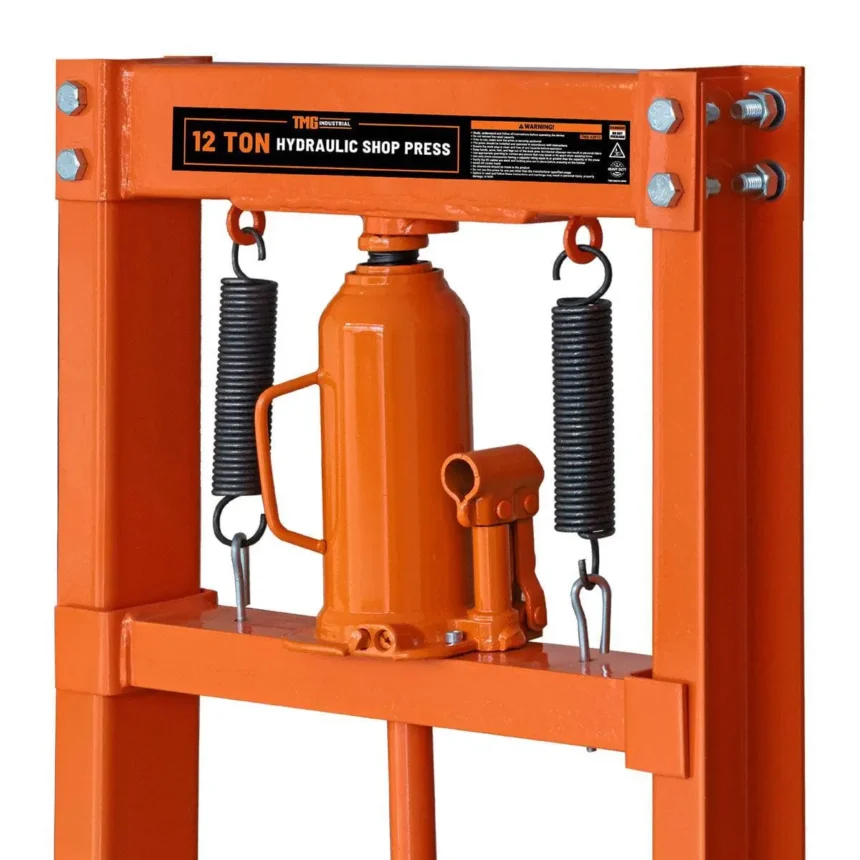
Strip a hydraulic shop press to its parts and it is remarkably simple. A bottle jack sits in the top of a welded H-shaped frame, pointing downward, while the work rests on a bed spanning the two uprights below. Turning the handle drives the jack, and the jack drives the ram onto the part.
The frame is doing more than holding the jack in place. Everything the ram pushes down with comes back up with equal force through the bed and into the two uprights, so the frame is one half of the working load rather than a stand the jack sits on.
Hand cranking trades speed for simplicity and price
A hand crank is what keeps a hydraulic shop press of this class affordable. There is no electric pump, no motor to wire in, and nothing to service beyond the jack itself, which is why the machine can sit unused for months and still work the day it is needed.
The cost of that simplicity is time and effort. Each stroke of the handle moves the ram a small distance, so closing a large gap means a great deal of pumping before any real pressure builds. For occasional repair work that is a fair trade, though a production shop would tire of it quickly.
Twelve tons covers more of a home shop than owners expect
Twelve tons sounds modest beside the machines in a heavy truck shop, but little of what a home workshop presses needs that kind of force. Wheel bearings, small bushes, universal joints, and the pins in mower and quad linkages nearly all give way well below the limit.
A hobbyist rebuilding a quad axle in a Manitoba garage found every bearing on the machine seated and drew out without ever approaching the top of the gauge. The tonnage that matters is the tonnage the job asks for, not the largest number available in a catalog.
A short ram stroke is the reason the bed has eight positions
This is the detail that explains the design, and it is easy to overlook. A bottle jack has a limited stroke, so the ram can only travel so far before reaching the end of its extension. If the work sits low, most of that travel is spent closing the empty air between them.
Moving the bed is how that problem is solved. By lifting the bed on its pins to one of eight positions, the operator brings the workpiece up close to the ram before pumping begins, so nearly the whole stroke is available for the actual pressing rather than for reaching.
Read that way, the adjustable bed is not a convenience feature at all. It is what makes a short-stroke jack practical across parts of wildly different heights, from a thin bracket lying flat on the bed to a tall hub that has to stand on end beneath the ram.
Replacing hammer blows changes what survives the repair
The real argument for a press is not that it is stronger than a hammer but that it is gentler in the way that matters. A hammer delivers enormous force over a few thousandths of a second, and that shock travels through hardened parts, cracking races and brinelling the bearings it was meant to seat.
A hydraulic shop press applies its force slowly and holds it, so the part moves without ever taking a shock. The bearing arrives on the shaft square and undamaged, and the housing survives intact, which is often the difference between a repair that lasts and one that fails within a season.
How the work sits on the bed decides whether it presses true
The setup takes longer than the pressing and matters more. The part has to sit level and centered beneath the ram, supported so the force passes straight through it, with a clear opening beneath for the bearing or pin to travel into as it moves.
Plates, tubes, and sockets laid across the bed create that support, and choosing the piece that bears on the correct shoulder is most of the skill. Pushing on the wrong ring of a bearing, or leaving no space for a pin to exit, ruins parts that were serviceable a moment earlier.
Loading slowly is what lets an operator feel trouble coming
A press job is read rather than rushed. Working the handle in steady strokes lets the operator watch how the part responds, and a piece that has begun to move behaves quite differently from one that is still locked solid and merely being loaded harder.
Parts under load let go without warning
The danger in running a hydraulic shop press is never the slow push itself. It is the instant a stubborn part breaks free, shatters, or slips off its supports, when everything the frame and workpiece have stored is released at once and hard components can leave the machine at speed.
Hardened parts are the worst offenders because they fail suddenly rather than bending first. A guard or mesh around the working area, and a face shield on the operator, turn that moment from an injury into a startle and a mess on the floor.
Where the operator stands matters as much as what they wear
Standing to one side of the ram rather than square in front keeps a person out of the line anything would take if it let go. Keeping hands clear of the bed while pressure is on, and releasing it gently rather than dumping it, are the habits that make the tool routine.
- Face shield: worn before any pressure is built
- Stand aside: never square in front of the ram
- Guard the zone: mesh contains what breaks loose
- Release slowly: let the pressure down, never dump it
Presses divide by how the force is made and framed
- Bench press: light work, mounts to a bench
- Hand crank H-frame: occasional repairs, floor standing
- Air over hydraulic: faster cycling for daily use
Where a twelve ton hand press fits and where it runs out
- Strength: seats and frees parts without hammering
- Strength: simple, affordable, nothing to wire in
- Limit: pumping by hand is slow on big gaps
- Limit: heavy truck and industrial work needs more
Weighed against a larger powered machine, this hydraulic shop press gives up speed and capacity in exchange for a price and a footprint that a single garage can justify. For a shop that presses something once a month rather than once an hour, that is the better bargain.
Home workshops keep taking back the repairs they once sent out
As parts and labor both grow more expensive, owners are doing more of their own bearing, bush, and linkage work rather than paying a shop to press a component they could handle at home. A modest press is often the single tool that makes that shift possible.
That steady move toward do-it-yourself repair is changing what a home garage is expected to hold, and a press is often the first serious machine to arrive. It is why the workshop equipment that TMG Industrial supplies runs from compact hand-operated frames through to the heavy powered machines a professional floor demands.
A twelve ton press is sized for the repairs a home workshop actually meets
The jobs that stall a home workshop are rarely about strength
Late summer is when Canadian garages fill up with the machines a season has worn out, and almost every teardown eventually reaches a part that will not come apart by hand. The tool that settles those moments is a hydraulic shop press, and a twelve ton frame is sized squarely at the work a home shop actually meets.
Most repairs stall not because the owner lacks force but because there is nowhere to apply it squarely. A bearing seated on a shaft, a bush frozen in a housing, or a pin rusted into a linkage all need a steady, aligned push that a hammer and a drift can only approximate.
A bottle jack held in a steel frame is the whole machine
Strip a hydraulic shop press to its parts and it is remarkably simple. A bottle jack sits in the top of a welded H-shaped frame, pointing downward, while the work rests on a bed spanning the two uprights below. Turning the handle drives the jack, and the jack drives the ram onto the part.
The frame is doing more than holding the jack in place. Everything the ram pushes down with comes back up with equal force through the bed and into the two uprights, so the frame is one half of the working load rather than a stand the jack sits on.
Hand cranking trades speed for simplicity and price
A hand crank is what keeps a hydraulic shop press of this class affordable. There is no electric pump, no motor to wire in, and nothing to service beyond the jack itself, which is why the machine can sit unused for months and still work the day it is needed.
The cost of that simplicity is time and effort. Each stroke of the handle moves the ram a small distance, so closing a large gap means a great deal of pumping before any real pressure builds. For occasional repair work that is a fair trade, though a production shop would tire of it quickly.
Twelve tons covers more of a home shop than owners expect
Twelve tons sounds modest beside the machines in a heavy truck shop, but little of what a home workshop presses needs that kind of force. Wheel bearings, small bushes, universal joints, and the pins in mower and quad linkages nearly all give way well below the limit.
A hobbyist rebuilding a quad axle in a Manitoba garage found every bearing on the machine seated and drew out without ever approaching the top of the gauge. The tonnage that matters is the tonnage the job asks for, not the largest number available in a catalog.
A short ram stroke is the reason the bed has eight positions
This is the detail that explains the design, and it is easy to overlook. A bottle jack has a limited stroke, so the ram can only travel so far before reaching the end of its extension. If the work sits low, most of that travel is spent closing the empty air between them.
Moving the bed is how that problem is solved. By lifting the bed on its pins to one of eight positions, the operator brings the workpiece up close to the ram before pumping begins, so nearly the whole stroke is available for the actual pressing rather than for reaching.
Read that way, the adjustable bed is not a convenience feature at all. It is what makes a short-stroke jack practical across parts of wildly different heights, from a thin bracket lying flat on the bed to a tall hub that has to stand on end beneath the ram.
Replacing hammer blows changes what survives the repair
The real argument for a press is not that it is stronger than a hammer but that it is gentler in the way that matters. A hammer delivers enormous force over a few thousandths of a second, and that shock travels through hardened parts, cracking races and brinelling the bearings it was meant to seat.
A hydraulic shop press applies its force slowly and holds it, so the part moves without ever taking a shock. The bearing arrives on the shaft square and undamaged, and the housing survives intact, which is often the difference between a repair that lasts and one that fails within a season.
How the work sits on the bed decides whether it presses true
The setup takes longer than the pressing and matters more. The part has to sit level and centered beneath the ram, supported so the force passes straight through it, with a clear opening beneath for the bearing or pin to travel into as it moves.
Plates, tubes, and sockets laid across the bed create that support, and choosing the piece that bears on the correct shoulder is most of the skill. Pushing on the wrong ring of a bearing, or leaving no space for a pin to exit, ruins parts that were serviceable a moment earlier.
Loading slowly is what lets an operator feel trouble coming
A press job is read rather than rushed. Working the handle in steady strokes lets the operator watch how the part responds, and a piece that has begun to move behaves quite differently from one that is still locked solid and merely being loaded harder.
Parts under load let go without warning
The danger in running a hydraulic shop press is never the slow push itself. It is the instant a stubborn part breaks free, shatters, or slips off its supports, when everything the frame and workpiece have stored is released at once and hard components can leave the machine at speed.
Hardened parts are the worst offenders because they fail suddenly rather than bending first. A guard or mesh around the working area, and a face shield on the operator, turn that moment from an injury into a startle and a mess on the floor.
Where the operator stands matters as much as what they wear
Standing to one side of the ram rather than square in front keeps a person out of the line anything would take if it let go. Keeping hands clear of the bed while pressure is on, and releasing it gently rather than dumping it, are the habits that make the tool routine.
- Face shield: worn before any pressure is built
- Stand aside: never square in front of the ram
- Guard the zone: mesh contains what breaks loose
- Release slowly: let the pressure down, never dump it
Presses divide by how the force is made and framed
- Bench press: light work, mounts to a bench
- Hand crank H-frame: occasional repairs, floor standing
- Air over hydraulic: faster cycling for daily use
Where a twelve ton hand press fits and where it runs out
- Strength: seats and frees parts without hammering
- Strength: simple, affordable, nothing to wire in
- Limit: pumping by hand is slow on big gaps
- Limit: heavy truck and industrial work needs more
Weighed against a larger powered machine, this hydraulic shop press gives up speed and capacity in exchange for a price and a footprint that a single garage can justify. For a shop that presses something once a month rather than once an hour, that is the better bargain.
Home workshops keep taking back the repairs they once sent out
As parts and labor both grow more expensive, owners are doing more of their own bearing, bush, and linkage work rather than paying a shop to press a component they could handle at home. A modest press is often the single tool that makes that shift possible.
That steady move toward do-it-yourself repair is changing what a home garage is expected to hold, and a press is often the first serious machine to arrive. It is why the workshop equipment that TMG Industrial supplies runs from compact hand-operated frames through to the heavy powered machines a professional floor demands.