


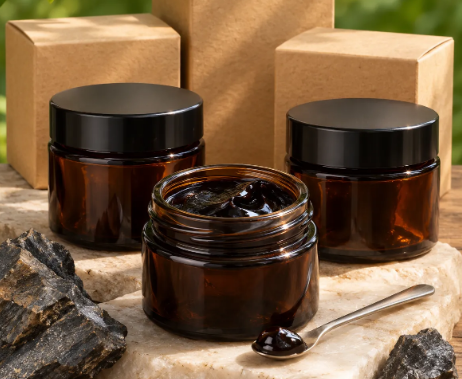
Shilajit Resin is a sticky, dark brown to black substance that seeps out of rock crevices in high mountain ranges, most famously the Himalayas. Ayurvedic texts have described it for centuries under the name shilajatu. A similar material shows up in Central Asian folk medicine as mumijo.
Interest in Shilajit Resin now reaches well beyond traditional practice, and that interest raises fair questions. What is it actually made of? How does a raw rock exudate become something fit to consume? And how much of the popular talk is backed by research? This post works through each point, along with the testing steps that separate a clean batch from a risky one.
How Shilajit Forms in Mountain Rock
The exact origin of shilajit is still debated. One Ayurvedic research review notes that, as its nature of origin is not understood clearly, it has not been categorized absolutely as mineral, plant, or animal origin. The most widely accepted explanation is that plant matter trapped between rock layers breaks down slowly over very long periods. When summer heat warms the rock, the softened residue oozes out through cracks.
Collectors scrape this material straight off the rock face. At that stage it is mixed with sand, stone chips, plant fibre and other debris. Raw shilajit is never ready to use as collected.
What Is Actually Inside the Resin
The short answer is that nobody has a complete chemical map yet. A 2023 review in Critical Reviews in Analytical Chemistry concluded that its chemical composition is not known with certainty.
The broad outline is clearer, though.
Fulvic Acid and Humic Substances
Most of the material is humic matter. Shilajit is composed of 60–80% humic substances, such as humic and fulvic acids. Fulvic acid gets the most attention because it is the compound labs measure most often when they grade a sample.
Levels vary widely by product type. According to ConsumerLab, purified resins are about 6% to 7% fulvic acid, while extracts are approximately 60% to 80% fulvic acid. That gap matters. A resin and a concentrated extract can carry the same name and still differ chemically by a wide margin.
Minerals, Amino Acids and Other Compounds
Beyond humic substances, the same 2023 review lists minerals such as potassium and magnesium, amino acids (mainly glycine) and proteins, fatty acids, bioactive compounds such as caffeic acid and gallic acid, and heavy metals including chromium, selenium, and cobalt. Researchers have also studied a group of compounds called dibenzo-alpha-pyrones, which turn up repeatedly in the literature alongside fulvic acid.
The exact mix depends on where the material was collected. Himalayan samples differ from Altai or Tian Shan samples, so two batches from different regions should not be treated as interchangeable.
From Raw Exudate to Purified Resin
Purification turns rough mountain material into a usable resin. Traditional Ayurvedic purification, known as shodhana, follows a simple pattern that modern processing still broadly mirrors:
- Dissolving the raw material in water or a herbal decoction
- Letting heavy debris settle out
- Filtering the liquid to remove fine particles
- Slowly concentrating the filtered liquid until it thickens into resin
The finished product is soft and semi-solid at room temperature. It turns brittle in the cold and becomes pliable again when warmed, which is one of the simple checks people use to judge authenticity. A smoky, earthy smell is normal.
Problems start when this process is rushed or skipped. Poor filtering leaves grit behind, while added fillers or thickeners change the composition without any visible sign.
Why Heavy Metal Testing Cannot Be Skipped
Shilajit forms inside rock, so some mineral content is expected. The concern is toxic metals such as lead, arsenic, mercury and cadmium.
Ayurvedic products as a whole have a mixed record here. A 2008 study in JAMA found that one-fifth of these products contain levels of lead, mercury or arsenic that exceed acceptable standards. That study covered Ayurvedic medicines broadly, not shilajit alone. Still, it shows why batch-level testing is the norm for any rock-derived traditional ingredient.
What a Certificate of Analysis Should Show
A certificate of analysis, often shortened to COA, is the document that records lab results for a specific batch. A useful one covers:
- Fulvic acid content, along with the test method used
- Lead, arsenic, mercury and cadmium levels against stated limits
- Microbial counts, including yeast and mould
- Moisture and water-insoluble matter
- A batch number that matches the product label
A COA without a batch number or test method is hard to verify. Independent third-party testing adds another layer of confidence on top of in-house results.
What the Research Does and Does Not Show
This is where caution pays off. A review in Current Nutrition and Food Science reported that the pharmacological effects studied so far are mainly attributed to the presence of humic acid, fulvic acid, dibenzo-α-pyrones, dibenzo- α-pyrones chromoproteins and trace elements. The same review called for more work, stating that regulatory and governmental impetus to basic and clinical research, safety testing and formulations quality control is warranted.
Most published work comes from laboratory and animal studies, plus a small number of human trials, often in healthy adults. ConsumerLab’s assessment is blunt: there is very little clinical evidence to support these uses.
Traditional use and early findings are worth studying. Neither one proves a health outcome. Anyone considering regular use, especially alongside prescription medication or during pregnancy, should talk to a qualified medical practitioner first.
Questions Worth Asking About Any Shilajit Resin
Whether the goal is research, formulation or personal use, a few questions help sort reliable material from the rest:
- Which mountain region did the raw material come from?
- What purification method was used, and was the resin ever sold raw?
- Is fulvic acid measured per batch, and by which method?
- Does every batch come with a full heavy metal panel?
- Are there any fillers, colourants or blended powders?
Clear answers to these five questions say more about a resin than any label claim. Shilajit has a long history, but its chemistry is still being worked out. Careful sourcing and honest testing are the most dependable guides available right now.